

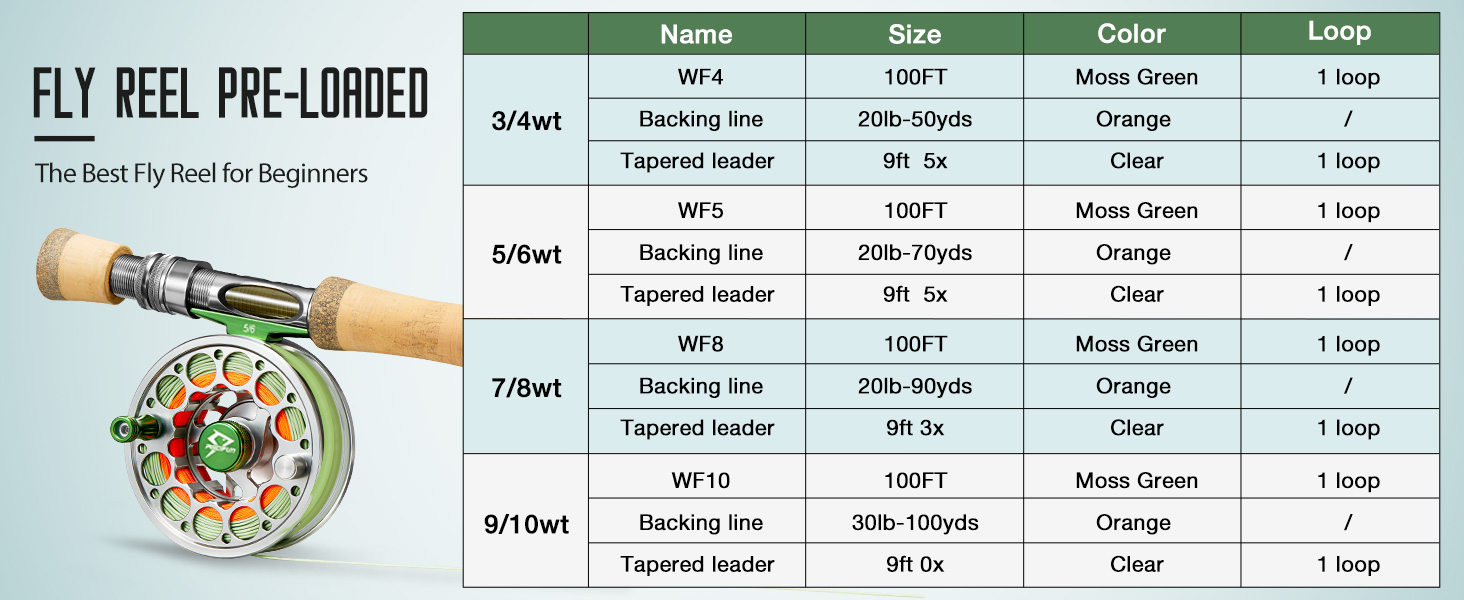
Short version: Reel size is matched to your rod and line weight. The four classes (3/4wt, 5/6wt, 7/8wt, 9/10wt) tell you what weight line and how much backing you typically run, plus a few other practical differences for fishing trout in mid fall.
- Line weight pairing: The numbers map to the rod and line you should use. The chart shows the corresponding WF line for each class (3/4wt uses WF4, 5/6wt uses WF5, 7/8wt uses WF8, 9/10wt uses WF10). Match your rod to the same weight class.
- Backing capacity: Heavier reels have bigger spools/arbors and can hold more backing, which is crucial for long runs or bigger fish. In the table: 3/4wt ~50 yds of 20 lb backing, 5/6wt ~70 yds, 7/8wt ~90 yds, 9/10wt ~100 yds.
- Tapered leader: The leader length and tippet size pair with the line weight. Lighter setups use finer leaders (5x, 3x); heavier setups use thicker tippet (0x) when you’re targeting bigger trout or steelhead.
- Arbor/drag and retrieval: Heavier reels often feature larger arbors and sturdier drags for quicker line pickup and better control during a fight.
- Practical picks: - Small streams and light tippet: 3/4wt.
- Versatile trout fishing: 5/6wt.
- Bigger rivers or bigger fish: 7/8wt or 9/10wt.
Weather note for mid fall: cooler water can slow fish and increase line memory, so a reel with solid backing and a good arbor helps you keep tension and retrieve line efficiently during longer drifts or fights. If you’re targeting bigger browns or steelhead in chilly mornings, lean toward the 7/8wt–9/10wt range.
Recommended setups you can check out:
If you want, tell me your usual water type (stream, river), target species, and typical fall conditions and I’ll tailor a specific 3/4/5/6 or 7/8/9/10 setup for you. Tight lines! 😊


